Translate

Visualizzazione post con etichetta Iraq. Mostra tutti i post

venerdì 22 febbraio 2019

Serwan Baran per l'Iraq


Ruya Foundation announces Serwan Baran will represent Iraq at the 58th Venice Biennale


The Ruya Foundation is delighted to announce that Serwan Baran will represent Iraq at the 58th Venice Biennale, presenting a solo exhibition which will run from 11 May to 24 November 2019. This will be the fourth National Pavilion of Iraq commissioned by the Ruya Foundation and follows the critical success of ‘Archaic’ which Ruya commissioned for the 57th edition of the Biennale in 2017. This is the first time Iraq will be represented by a solo artist at the Biennale. 

Iraqi-Kurdish artist Serwan Baran was born in Baghdad in 1968, and is considered part of the ‘new generation’ of Iraqi painters. He has lived through over 40 years of war in his country and was conscripted during conflicts in the 1980s and 1990s. During his time as a soldier and war artist, Baran was obligated to record the victories of the Iraqi army for government propaganda. His work became more expressionist when he began addressing his own military experience by deconstructing images of generals in grotesque, figural abstractions. Baran describes this artistic period as an attempt to silence “the nightmare inside me”. 
The large-scale and site-specific works of ‘Fatherland’ will invoke the feeling of a war zone upon entering, in line with Baran’s signature dark and atmospheric style. The exhibition will feature a monumental acrylic painting, The Last Meal, depicting a bird’s-eye view of soldiers killed during their last meal. Elements ofcollage will be incorporated, including objects from Iraqi military uniforms given to the artist by families of the deceased. These uniforms were collected from the Iran-Iraq War, the second Gulf War and the war with ISIS. 
The exhibition will also include a sculptureThe Last General, a life-size clay replica of an army general inside a sunken life boat cast in fibreglass. The figure of the general is sculpted so that half of his body appears decayed, while the other half appears intact and wears a uniform and medals. The sculpture will also include elements of collage, using cloth from military uniforms. Resembling an ancient mummy in a sarcophagus, this clay coloured sculpture is intended as a reminder of the brutality of military leaders, as well as a tribute to perished men who have become part of the soil. 
Iraq and the region have endured reigns of terror and authoritarian rule in the name of nationalist and religious ideologies, often driven by the need to wage war both in competition for, and in defence of, the ‘Fatherland’. The term al-watan (meaning ‘homeland’ or ‘nation’) is used by dictators in demagogic speeches and in fascist literature. The exhibition is a commentary on the masculine and paternalistic dimensions of political culture in Iraq and the region. 
In particular, Baran seeks to interrogate the ways in which the notion of the ‘Fatherland’ has been used to justify the horrors of war, the soldier’s efforts, and a leader’s tactics. The soldier, often depicted as a valiant and obedient hero, is more often a victim of brutal authority. Through an examination of the abuse of the patria, the exhibition is also an exploration of the nature of man, his indulgence to his violent nature, and to his own dictatorial instincts that find an outlet through war.
Tamara Chalabi, Chair and Co-Founder of the Ruya Foundation and co-curator of the exhibition has said:
“It is an important development for this pavilion to have a solo artist represent Iraq for the first time. Serwan Baran’s work is fitting artistically, both as a deeply personal testimony of his own experiences and a universal commentary on the condition of mankind. I am pleased to also be sharing his singular expressionist style as a painter, in a medium that has great significance within the history of modern Iraqi art.”
Paolo Colombo, co-curator has said:
“Serwan Baran’s large-scale works are forceful denunciations of the horrors of war. They are meant to overwhelm the viewer, as one is overwhelmed in the proximity of a large film screen. His statement is not restrained, and the scale of his works is in perfect tune with the volume of his proclamation.” 

mercoledì 22 marzo 2017

Iraq Pavilion at the 57th Venice Biennale


Press Release 

Iraq Museum loans ancient and retrieved artefacts for the first time for the 

Iraq Pavilion at the 57th Venice Biennale 

The Ruya Foundation is pleased to announce further details for the National Pavilion of Iraq at the 57th Venice Biennale in May 2017. The exhibition, ‘Archaic’, will show the work of eight Modern and contemporary Iraqi artists in dialogue with 40 ancient Iraqi artefacts drawn from the Iraq Museum and spanning six millennia, from the Neolithic Age to the Neo-Babylonian Period. Most of these objects have never left Iraq, excluding a few that were recently recovered after the 2003 lootings of the Museum. The exhibition will also be accompanied by a new commission by internationally acclaimed Belgian-born artist Francis Alÿs on the subject of war and the artist. 

‘Archaic’ will be the third occasion on which the Ruya Foundation has commissioned the National Pavilion of Iraq at Venice. The tension in the term ‘Archaic’ is drawn from its multivalent references to the ancient and primordial, as well as what is currently out of use. The exhibition will draw out this tension to emphasise its particular relevance to Iraq, a country whose existing political, administrative, social and economic reality is arguably as ‘archaic’ as its ancient heritage. The exhibition will be co-curated by Tamara Chalabi (Chair and Co-Founder of the Ruya Foundation) and Paolo Colombo (Art Adviser at the Istanbul Museum of Modern Art). The curators have said: “In exploring Iraq’s artistic heritage from the Neolithic Age to the present, ‘Archaic’ will also explore the different ways in which Iraq’s ancient past has affected its Modern and contemporary visual languages, examining the opportunities and restrictions presented to the nation by its immense ancient inheritance, in the context of today’s fragile reality.” 

There will be 40 ancient objects on display, from as far back as the Halaf Period (6,100–5,100 BCE) and as far forward as the Parthian Period (247 BCE–224 CE). Artefacts in stone, glass and clay will incorporate cylinder and stamp seals, cuneiform tablets, medical objects, a musical instrument and figurines of animals, deities, people and boats, as well as everyday objects such as jugs, sieves and toys. A number of objects were returned to the Museum via Interpol in 2008 and 2010, from territories including the Netherlands, Syria and the United States. They include a Babylonian stone weight measure in the shape of a duck and an exquisite clay figurine depicting what is presumed to be a fertility goddess dating from around 6,000 BCE. The artefact selection was made by co-curator Tamara Chalabi in collaboration with Qais Hussein Rashid, the Director of the Department of Antiquities at the Iraq Museum, his team and archaeologist Lamia Gailani Werr. 

Other intriguing highlights will include a contract of adoption from the Babylonian Period, which is remarkable for the fact that both tablet and envelope have remained intact together, as well as decorative stamps used by each witness to sign their names. Also displayed will be a distinctive cylinder seal from the Akkadian Period depicting three parallel scenes from Gilgamesh and a circular clay school text from the Babylonian Period that was used to teach writing. The ancient artefacts will allow the exhibition to examine the archaic as a signifier for universal themes that are a precursor to any civilization. The curators have identified seven such themes and each contemporary work can be seen through the prism of one of them. They are water, earth, the hunt, writing, music, conflict and exodus. All works will be displayed in custom-designed vitrines, mirroring the museum-style display associated with the exhibition of antiquities, as well as the landmapping practices of archaeologists. They will also mean that each presentation can be read as an individual chapter as well as in the wider context of ‘Archaic’. The exhibition space – a historically listed, disused library, added during a 19th-century neo-gothic expansion of the Palazzo – will also echo the ‘archaic’ theme. 


The work of eight Iraqi artists will be on display. Of the six living artists, five will create new work for the Pavilion. Many artists working in Iraq today continue to abide by an orthodox aesthetic tradition that has been limited by mid-century education trends and the lack of cultural exchange in Iraq in recent decades. All of the Ruya Foundation’s work seeks to nurture and promote artists who move beyond these paradigms and as such installation, video and photography will be represented alongside more traditional media such as painting and sculpture. Works by contemporary artists Sherko Abbas (b. 1978), Sadik Kwaish Alfraji (b. 1960), Ali Arkady (b. 1982), Luay Fadhil (b. 1982), Nadine Hattom (b. 1980) and Sakar Sleman (b. 1979) will interplay with works by two Modern Iraqi artists, Jewad Selim (1919–1961) and Shakir Hassan Al Said (1925–2004). 

As pioneers of the Iraqi Modern tradition, Selim and Al Said were amongst the first to strive for a new kind of Iraqi art in the 20th century, that would both engage with the European avant-garde and create a distinctly Iraqi vernacular responding to the country’s unique ancient heritage. 

Painter and sculptor Jewad Selim is widely recognised as the father of Iraqi Modern art and was highly influential across the region as a whole. He was one of the first Iraqi artists to study fine art in Europe and his experience at the Slade School of Fine Art in 1930s London meant that he combined Modern European influences with initial artistic training at the Iraq Museum. Selim wanted to create a new vernacular language for Iraq and is known for paintings that combined abstract forms with Mesopotamian iconography, as well as the Liberty Monument in Baghdad, which celebrates the 1958 revolution. Two important Selim works will be shown, including The Hen Seller (1951), which has not been displayed in public since its first showing in Iraq in the 1950s. 

Shakir Hassan Al Said was a painter, sculptor and writer and a student of Selim’s. He too was deeply concerned with finding a new language for Iraqi art and together the pair established the Baghdad Modern Art Group in 1951. This group reflected a growing nationalist and anti-colonial sentiment. A number of Al Said’s paintings from the 1960s will be on display. He developed an intense interest in the divine and turned towards Sufism, abstraction and a fascination with the Arabic script. It is noteworthy that in 2003, alongside the lootings at the Iraq Museum, the Saddam Art Centre was also looted and the Selim and Al Said galleries emptied. This act represented a violation of uniquely Iraqi heritage and it is telling that international notice of the lootings has focused on Mesopotamian objects, which can be said to be items of world heritage. 

The exhibition will display the connection between contemporary and Modern art in Iraq, showing how that connection can further elucidate the relationship of both to the archaic. Both Nadine Hattom and Sakar Sleman will present new installation works. Hattom’s will take its point of departure as her own family heritage and the significance of water, while Sleman’s will look at the significance of the earth and its connection to people and to herself. Hattom is an Iraqi-Australian artist, based in Berlin. Her practice is based in photography and sculpture and brings together everyday objects to reflect on language, identity and representation. Her Pavilion commission will explore the traditions of the Mandaean community, a religious group from southern Iraq to which her family belongs. 
The Mandaeans particularly revere John the Baptist and many of their cultural practices relate to water. Hattom’s installation will explore this theme through objects that evoke the memories of her father and mother as well as the collective Mandaean memory. They will include photographs from a family album, inks and clay. 

Sakar Sleman’s installation will use soil and stone from the Kurdish mountains near her home to create a diorama of the world according to the artist. It will serve as a meditation on nature, and her relationship to it, as the origin of mankind. The abstractness of Sleman’s work, seen in her recurring references to the circular shape, is also linked to her preoccupation with women and their unheard voices in society. Sleman is based in Kurdistan and her work often combines text and slogans with land installation and found objects to focus on political and socio-cultural day-to-day life in Iraq. 

Three of the contemporary artists will incorporate film into their works, one focusing on the 
transmission of historical information in Iraq, another engaged with traditional writing practices and the other focused on music and travel in Iraq. Sadik Kwaish Alfraji creates artist books and animations. His Pavilion work will combine drawings with an animation in an installation that interrogates the way in which Iraqi school text books relay the narratives of the country’s past. Figures will walk through the ages and across manuscripts in the film, which will also touch upon fable, archaeology, religious lore and the hunt. Alfraji left Iraq in the 1990s after remaining in the country and producing work throughout the Iran-Iraq War. He is now based in the Netherlands and though greatly influenced by the European tradition, particularly the German Expressionists, his work retains a focus on Iraq. 

By contrast, Luay Fadhil’s film will be concerned with a different Iraqi tradition for the transmission of written information, an archaic practice that continues to exist in Baghdad today. Scribes set up makeshift offices outside public buildings to draw up official documents for visitors and passers-by. 

The film will focus on a man who visits one of these scribes daily in an attempt to communicate with his recently deceased wife, uniting Iraq’s present with its ancient history as the birthplace of writing. Fadhil is based in Baghdad and began working in film in 2009. Since then he has won awards at the Gulf Film Festival and the Dubai International Film Festival, amongst others. 

Sherko Abbas is a multimedia artist who works in video, performance, text and installation. Abbas is based in Sulamaniya but the principal footage for his installation was taken by his sister, a cellist in the Iraqi National Orchestra, on the occasion of its visit to the Kennedy Centre in Washington in December 2003. A split-screen presentation will display rehearsal footage in conjunction with scenes depicting the travel methods required to reach the United States. Numerous methods were used for the journey, including the use of military planes, addressing ideas around nomadism. The vitrine installation will also include sheet music, programmes and other historical records of this cultural exchange, which took place at a time that was particularly pertinent to relations between the two countries. The US invasion of Iraq had taken place in March of that year. 

The final contemporary artist in the selection is Ali Arkady, a photojournalist who has been reporting since 2010 on the volatile political realities of Iraq and has reported regularly from the front line since the 2014 ISIS attacks. A collection of his latest works from the ongoing Mosul campaign against ISIS will be on display, divided into three sections: images depicting how war affects soldiers, images depicting how war affects the land and images depicting how war affects civilians, focusing particularly on migration and thus being especially pertinent to the ongoing refugee crisis. 

Francis Alÿs 
‘Archaic’ will be accompanied by a new project by artist Francis Alÿs, who was born in Antwerp and is based in Mexico City. In February 2016 Alÿs undertook a trip to Iraq facilitated by the Ruya Foundation in which he visited refugee camps in the north of the country. He followed this with an extraordinary visit in November 2016 to the Mosul front line in the company of a Kurdish battalion, during the Liberation of Mosul offensive. The main line of enquiry for this new installation will be the role of the artist in war. The work will incorporate drawings, paintings, photographs and notes from Alÿs’ experience in Mosul. A video work will feature people on the move, against a backdrop of coalition bombing, continuing an investigation into the artist’s role as witness that was instigated during Alÿs’ first trip to Iraq and, in particular, his interactions with children in refugee camps. 


About the National Pavilion of Iraq 


Curators: Tamara Chalabi and Paolo Colombo 
Commissioner: Ruya Foundation 
Local commissioner: Vittorio Urbani 


‘Archaic’ will run 13 May – 26 November 2017 


The exhibition will be housed in the third floor of: 
Palazzo Cavalli-Franchetti, Grand Canal, San Marco 2847, Venice 
Nearest Vaporetto: Accademia (the palazzo is on the other side of the bridge) 


Opening hours: 10am – 6pm every day except Mondays 

Press preview: Wednesday 10 May, 11am – 1pm 

The exhibition will be accompanied by a catalogue published by Mousse, including essays by Zainab Bahrani, Roger Cook, Venetia Porter, Nada Shabout and Robert Storr, amongst others. 

About the Ruya Foundation 

The Ruya Foundation is an Iraqi registered non-profit, non-governmental organisation founded in 2012 with the aim of aiding and enriching culture in Iraq, and building cultural bridges with the world. Ruya’s initial goal is to promote culture in Iraq at a time when priorities are focused elsewhere and to build a platform that will enable Iraqis in the arts, the young in particular, to benefit from, and participate in international events. In addition to supporting local projects, Ruya’s aim is to create a network of intercultural events that can contribute to the development of civil society in Iraq. It is also committed to nurturing a multicultural dialogue through the arts. Ruya initiates and commissions creative projects in the visual, audiovisual and performing arts. Ruya was the commissioner of the 
National Pavilion of Iraq for the 56th and 55th Venice Biennales in May 2013 and May 2015. The 2015 Pavilion exhibition, ‘Invisible Beauty’, transferred to S.M.A.K. (Museum for Contemporary Art), Ghent (2016) and the Erbil Citadel, Iraq (2017). Ruya collaborated with international artist Ai Weiwei on a major publication Traces of Survival: Drawings by refugees in Iraq selected by Ai Weiwei (2015). In 2015 Ruya launched the first drama therapy project in Baghdad, supported by the Prince Claus Fund, and in 2016 it launched the first publically accessible online database of contemporary Iraqi artists, which can be found at www.ruyafoundation.org/en/artists. In addition, the Ruya website is a live platform for Iraqi art. Interviews with emerging and established artists both in Iraq and those based in the diaspora are published regularly to encourage dialogue, the exchange of ideas and promote the possibility of collaboration. In January 2017 Ruya launched a new educational publishing initiative, Ruya Notebooks. 

www.ruyafoundation.org 


martedì 28 aprile 2015

Invisible Beauty - Iraq Pavilion


Ruya Foundation announces plans for National Pavilion of Iraq at 56th Venice Biennale 2015 and a collaboration with Ai Weiwei


The Ruya Foundation for Contemporary Culture in Iraq (Ruya) is pleased to announce its plans for the National Pavilion of Iraq at the 56th Venice Biennale in May 2015. The exhibition, Invisible Beauty, will be curated by Philippe Van Cauteren, Artistic Director of S.M.A.K. (Museum for Contemporary Art). It will feature five contemporary Iraqi artists, two generations of Iraqi photographers, in the shape of Latif Al Ani and Akam Shex Hadi, visual artist Rabab Ghazoul, ceramicist and sculptor Salam Atta Sabri and painter Haider Jabbar. The exhibition will include new works that have been produced specifically for the exhibition as well as works that have been rediscovered after long periods of inattention. 


To accompany the exhibition, a catalogue will be published by Mousse Publishing in association with the Ruya Foundation. The catalogue will include original contributions by Seamus Kealy, Tamara Chalabi, Lamia Al-Gailani Werr, Fares Haram, Karen McKinnon, Ali Bader, Luk Lambrecht, Sherko Bekas, Atyaf Rasheed and Philippe Van Cauteren.

TRACES OF SURVIVAL: Drawings by Refugees in Iraq selected by Ai Weiwei

The exhibition will also be accompanied by a display of drawings made by refugees in northern Iraq. World renowned artist Ai Weiwei has selected a number of these drawings for a major publication that will launch at the Biennale, TRACES OF SURVIVAL: Drawings by Refugees in Iraq selected by Ai Weiwei.


Curator: Philippe Van Cauteren, Artistic Director, S.M.A.K.
Commissioner: Ruya Foundation for Contemporary Culture in Iraq
Local commissioner: Nuova Icona


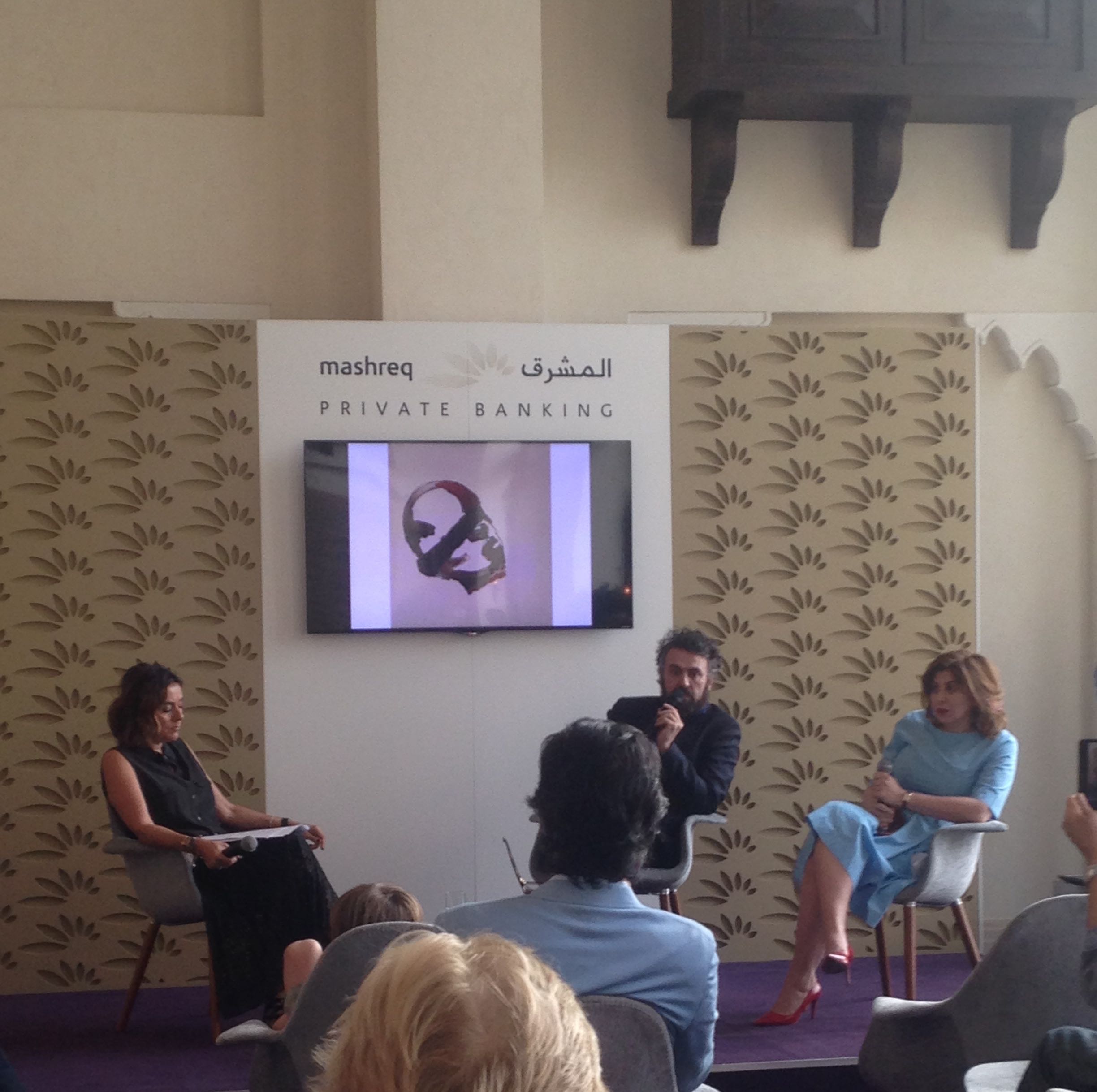
RUYA hosted a talk on art in Iraq at Art Dubai last week, to announce the artists selected for theNational Pavilion of Iraq at the 56th Venice Biennale and as well as shed light on the state of the arts in Iraq today.
Curator Philippe Van Cauteren introduced the theme of this year’s Pavilion, Invisible Beauty. The theme reflects on unusual or unexpected elements in the selected artists’ work, as well as the invisibility of Iraqi artists on the international stage.
RUYA's Reem Shather Kubba and Tamara Chalabi speak with curator Philippe Van Cauteren at Art Dubai
RUYA’s Reem Shather Kubba and Tamara Chalabi speak with curator Philippe Van Cauteren at Art Dubai
“Seeing the conditions of the city of Baghdad, and its institutions, we had to approach the notion of contemporary art differently,” he explained.
Van Cauteren also announced the selected artists for this year’s show, photographers Latif Al Ani and Akam Shex Hadi, visual artist Rabab Ghazoul, ceramicist and sculptor Salam Atta Sabri and painter Haider Jabbar, who currently has a year long residency in Samsun, Turkey, supported by RUYA.
All of these artists, he argues, “take a position on their own identity, through documenting, creating inventories or stocking up experiences together”.
“Last year we focused on artists from inside Iraq,” said Reem Shather-Kubba, “this year we want to create a dialogue between artists in Iraq and the diaspora.”
When asked about his trip to Iraq, Van Cauteren described it as a “reality check”. “As a curator,” he explained, “it grounds you and makes you reflect on what art means and should be”.
Van Cauteren hopes to curate an exhibition of international artists in Baghdad in the near future, as part of RUYA’s mission to build cultural bridges between Iraq and the world.
RUYA co-founders Reem Shather-Kubba, Tamara Chalabi and Shwan Taha spoke about the impact and challenges of supporting the arts from within Iraq.
As well as the logistical problems, such as transporting works or securing visas for curators and the artists, they explained that the cultural scene is still recovering from decades of conflict and trauma.
Highlighting the effects of an art scene that was largely state-driven until now, Tamara Chalabi said, “Art is a form of self-expression, but often, artists in Iraq do not do that. They are preoccupied with form and color, there is an implicit and often unconscious self censorship ”.
This became apparent during RUYA’s studio visits in Baghdad, where Philippe met and mentored artists, including those not selected for the Biennale.
Chalabi also displayed examples of street art, such as murals on blast walls and other attempts to beautify the city of Baghdad.
RUYA also announced their collaboration with Ai Weiwei on a major publication, Traces of Survival: Drawings by Refugees in Iraq Selected by Ai Weiwei. In December 2014 Ruya launched a campaign to provide drawing materials to adult men and women in refugee camps in northern Iraq. All 546 submissions, including drawings, poetry and prose, will go on display at the Pavilion and the publication will launch at the Biennale.


On 7 May 2015, as part of its programme for the National Pavilion of Iraq at the 56th Venice Biennale, RUYA is hosting a panel discussion on art, conflict and Iraq.
The panel will examine the role of art in conflict, and the ways in which artists’ contributions to this subject can be an effective element of change. Among the questions to be raised are:
  • Is the role of the arts increasingly relevant in communicating personal and political dimensions of a conflict – as a tool of self reflection and creativity that allows us to think outside of the boundaries constructed in conflict narratives?
  • Can art be a viable medium for resistance?
  • How has the public role of the artist changed?
  • Can art be a catalyst for recovering from trauma in post-conflict situations?
  • Can art be an alternative medium for communication (through images, symbols and personal narratives) in highly volatile situations where communication is difficult?
  • Despite decades of conflict, artists in the visual, literary and performing arts continue to practice within Iraq. The role that violence and trauma plays in the daily lives of these artists is impossible to ignore. The recent attacks and cultural cleansing make discussions about art in conflict zones more important than ever.
The panel speakers are:
Lamia Al-Gailani Werrleading archeologist who has written extensively on Iraqi archeology and cultural heritage, based at UCL, London.
Charles TrippProfessor of Politics at SOAS, London and author of A History of Iraq (2008) among others. He is a member Culture+Conflict, a UK based NGO.
Justine Hardy, author and trauma psychologist who founded the groundbreaking mental health project Healing Kashmir.
Kader AttiaFrench-Algerian artist who focuses on the aesthetics and ethics of different cultures, as well as the theme of reparation. He has appeared at international exhibitions like DOCUMENTA (2012).
Giles Keppel, political scientist and specialist of contemporary Middle Eastern politics, and author of The War for Muslim Minds: Islam and the West (2004).
Tamara Chalabi, historian and author, and chairman of Ruya Foundation that commissioned theNational Pavilion of Iraq at the Venice Biennale in both 2013 and 2015.
Philippe Van Cauteren, Artistic Director of S.M.A.K, Ghent and curator of the National Pavilion of Iraq at the 56th Venice Biennale.
Date: 7 May 2015

Time: 16.00-18.00

Please note that places at the panel are limited so booking is essential.
To request a place on the talk, please contact: RSVP@ruyafoundation.org

venerdì 20 marzo 2015

Iraq Pavilion


Variabilità irachena con "Invisible Beauty", un mix di forme e artisti che manifesta la ricca creatività islamica. Ci sarà la scultura di Salam Atta Sabri, l’azione performantiva di Rabab Ghazoul, gli scatti di Akam Shex Hadias e Latif Al Ani.

il progetto curato da Philippe van Cautereno ospiterà anche una raccolta di disegni di Ai Wei Wei. Sponsor dell’iniziativa Ruya Foundation.


English 
RUYA commissioned Invisible Beauty, the exhibition for the Iraq Pavilion at the 56th Venice Biennale. Curated by Philippe Van Cauteren, Artistic Director of S.M.A.K., Ghent, Invisible Beauty features five contemporary artists from across Iraq and the diaspora: two generations of Iraqi photographers, in the shape of Latif Al Ani and Akam Shex Hadi, performance artist Rabab Ghazoul, ceramicist and sculptor Salam Atta Sabri and painter Haider Jabbar.
Invisible Beauty refers both to the unusual or unexpected subjects in the works that will be on display and to the invisibility of Iraqi artists on the international stage. The relationship of art to survival, record-keeping, therapy and beauty are among the themes raised by the exhibition. It reveals art generated by a country that has been subjected to war, genocide, violations of human rights and, in the last year, the rise of Isis.
The systematic demolition of the cultural heritage of Iraq by Isis, has made it more important than ever to focus on artists continuing to work in Iraq. Van Cauteren made his selection following a journey to Iraq that was organised and facilitated by RUYA and carried out in company with Tamara Chalabi, the Foundation’s Chair and Co-founder.
In addition, over 500 drawings made by refugees in northern Iraq will be on display. Working with RUYA, world renowned artist Ai Weiwei has selected a number of these drawings for a major publication, Traces of Survival that will launch at the Biennale. The exhibition includes a catalogue with original essays, poetry and short stories by Iraqi writers, reflecting on the theme of Invisible Beauty. It is published by Mousse.


The Ruya Foundation for Contemporary Culture in Iraq (Ruya) is pleased to announce its plans for the National Pavilion of Iraq at the 56th Venice Biennale in May 2015. The exhibition, Invisible Beauty, will be curated by Philippe Van Cauteren, Artistic Director of S.M.A.K. (Museum for Contemporary Art) in Ghent. It will feature five contemporary artists from across Iraq and the diaspora. The artists work in a range of media and the Pavilion will include new works that have been produced specifically for the exhibition as well as works that have been rediscovered after long periods of inattention. The exhibition will be accompanied by a display of over 500 drawings made by refugees in northern Iraq. World renowned artist Ai Weiwei has selected a number of these drawings for a major publication that will launch at the Biennale. ‘Invisible Beauty’ refers both to the unusual or unexpected subjects in the works that will be on display and to the inevitable invisibility of Iraqi artists on the international stage. The relationship of art to survival, record-keeping, therapy and beauty are amongst the many themes raised by the exhibition. The endlessly interpretable title is intended to reveal the many different ways of approaching art generated by a country that has been subjected to war, genocide, violations of human rights and, in the last year, the rise of Isis. The systematic demolition of the cultural heritage of Iraq by Isis, seen recently in the destruction of centuries-old historical sites at Hatra, Nimrud and Nineveh and the events at the Mosul Museum, has made it more important than ever to focus on artists continuing to work in Iraq. Curator Philippe Van Cauteren has said: ‘Invisible Beauty is like a fragile membrane that registers the oscillations of an artistic practice permeated by the current condition of the country and the state of the arts.’ The artists in the exhibition will comprise two generations of Iraqi photographers, in the shape of Latif Al Ani and Akam Shex Hadi, performance artist Rabab Ghazoul, ceramicist and sculptor Salam Atta Sabri and painter Haider Jabbar. This selection was chosen by Van Cauteren following a journey to Iraq that was organised and facilitated by Ruya and carried out in company with Tamara Chalabi, the Foundation’s Chair and Co-founder. Van Cauteren and Chalabi also visited Iraqi artists working in the US, Turkey, Belgium and the UK. Both Al Ani and Atta Sabri are based in Baghdad, whilst Shex Hadi is based in Iraqi Kurdistan and Jabbar and Ghazoul work outside of Iraq, in Turkey and Wales respectively. A great number of Iraqi artists continue to practise an orthodox aesthetic tradition that is constrained by classical education methods. The Pavilion artists represent a break from these traditional constraints, both in terms of style and media and in terms of wider social concerns such as gender and age. All of the artists relate to the current political situation in their work, negotiating between ethics and aesthetics, social concerns and artistic values. With the artists’ ranging ages, the exhibition in some ways represents a mental and emotional history of Iraq and seeks to ask what the word ‘contemporary’ can mean for a nation that lacks a well developed cultural infrastructure. Latif Al Ani (b. 1932) is considered the founding father of Iraqi photography and his extensive documentary career spans from the late 1950s to the late 1970s, when it became impossible to photograph in public due to the increasingly authoritarian atmosphere of the Saddam regime and the Iran-Iraq War. A duality of thinking makes both modernising trends and the retention of ancient traditions themes of Al Ani’s work and the Pavilion exhibition will focus on works from the early period of his career. By contrast, Akam Shex Hadi (b. 1985) represents a later generation of Iraqi photography and his staged, symbolic works have seen him participate in photography festivals across Asia and the Middle East. His work, along with that of Haider Jabbar, is concerned with the rise of Isis and the refugee crisis. He has created a new work for the Pavilion that consists of 28 photographs. A recurrent motif in the series is an unwinding thread, which resembles a snake but is revealed to be the Isis flag, a continuous reminder of its ensnaring qualities. Shek Hadi will also present a series of aerial photographs depicting what appears to be a large floor clock, except that the digits are not in their expected positions. A prostrate figure representing a hand of the clock makes the works a rumination on human capitulation to time, a kind of momento mori. Painter Haider Jabbar (b. 1986) will show a series of watercolour portraits reflecting on the Isis crisis and the numerous victims it has claimed. These works are shocking, often brutal, renditions of the fates of young men who have died in the conflict. The men are identified only by case numbers and Jabbar, who considers himself part of a generation of young men who have had their lives needlessly ruined by decades of conflict in Iraq, intends to make 2,000 of these works. Jabbar is himself a refugee, now living and working in Turkey with the support of the Ruya Foundation. Rabab Ghazoul (b. 1970) also responds to her particular geographical relationship to Iraq in her work. Based in Wales, Ghazoul is producing a new performance work for the Pavilion that will take the Chilcot Enquiry for its point of departure. Ghazoul’s work investigates our relationship with political and social structures and part of this new work will be an inventory of official testimonies about the Iraq war, newly spoken by anonymous British citizens. This aspect of the work highlights three of the exhibition’s key themes – art as an act of cataloguing, the correlation between the moment that a work is made and its formal qualities and ideas about what constitutes community. Ghazoul, who will be the only female artist on display, has had several solo exhibitions in Cardiff and has participated in numerous group exhibitions in Wales and the rest of Europe. Salam Atta Sabri (b.1953) has worked extensively in arts administration in Iraq and abroad but despite training as a ceramicist and drawing extensively, he has never shown his drawings in public. He produced some 300 drawings between 2012 and 2015 that he has never shown in public and more than 100 of them will appear at the Pavilion. These intensely personal works exhibit the experience of an artist striving to create under the shadow of a crumbling arts infrastructure. Atta Sabri returned to Baghdad in 2005 after having lived in the US and Jordan for 16 years and his drawings can be understood as a diary in which the artist addresses the existential tragedy he undergoes returning to his native city. As more and more ancient sites and shrines that are part of the universal heritage of Iraq are being destroyed, Ruya believes it is more important than ever to focus on artists who continue to work in such difficult circumstances. The Pavilion will provide a platform to make these artists visible. TRACES OF SURVIVAL: Drawings by Refugees in Iraq selected by Ai Weiwei The exhibition will be accompanied by a display of drawings made by refugees in northern Iraq. In December 2014 Ruya launched a campaign to provide drawing materials to adult men and women in refugee camps. Ruya visited Camp Shariya, Camp Baharka and Mar Elia Camp and over five days the Foundation collected 546 submissions, including drawings, poetry and prose, all of which will be on display. The submissions present incredibly powerful responses to life within the refugee camps. A depiction of tanks and aircraft returning fire on each other was drawn by a forty-year-old man carrying the caption, ‘our people have only lived amongst wars and destruction’, whilst another image depicts an isolated figure in a flooded refugee camp who petitions, ‘save us from drowning. I am Iraqi’. By contrast, other drawings depict life before the refugee crisis, including a shining depiction of Mosul before Isis took control and a depiction of a traditional Yazidi festival. A number of these images have been selected by Ai Weiwei for a major publication, TRACES OF SURVIVAL: Drawings by Refugees in Iraq selected by Ai Weiwei, that will be published to coincide with the Biennale. Proceeds from the book will go back to those who provided the content.

mercoledì 19 novembre 2014

Philippe Van Cauteren curatore per l'Iraq


Annunciato il curatore per l'Iraq, Philippe Van Cauteren, per l'evento che avrà sede presso Ca’ Dandolo.  Supporta l'evento la  Fondazione Ruya .


Info da sito http://www.theiraqpavilion.com/

Ruya Foundation for Contemporary Culture in Iraq (RUYA) is delighted to announce the appointment of Philippe Van Cauteren as curator of the National Pavilion of Iraq for the 56th Venice Biennale in May 2015. The appointment follows the great success of Welcome to Iraq, which RUYA commissioned for the 55th edition of the Biennale in 2013.
Philippe Van Cauteren, artistic director of S.M.A.K. Museum for Contemporary Art in Ghent and who co-curated the Belgian Pavilion in 2013, has been appointed by RUYA to curate a pavilion that resonates with the rich scope of Iraqi identity extending beyond the country’s fragile borders. Van Cauteren is currently in conversation with a range of artists from various disciplines and he will finalise his vision for the exhibition after a trip to Iraq, organised and facilitated by RUYA.
Van Cauteren’s commitment to nurturing and empowering Iraqi artists also extends beyond the Biennale. He said, ‘the Pavilion exhibition will constitute the beginning of a continued relationship with RUYA, working to enable a new generation of Iraqi artists to transcend their geography and prosper on a global scale.’
Chairman of RUYA Tamara Chalabi said, ‘Philippe Van Cauteren is suitably positioned to explore Iraq’s complicated terrain, having worked in diverse international contexts, as well as further enlarging S.M.A.K.’s artistic focus. At this very critical juncture in Iraq’s existence, RUYA believes that the presence of a National Pavilion of Iraq at Venice will act as a crucial ambassador for the endurance of Iraqi contemporary culture.’

The Commissioning Body

Ruya Foundation for Contemporary Culture in Iraq (RUYA) is an Iraqi registered non-profit, non-governmental organization founded in 2012 by Iraq art and culture enthusiasts with the aim of aiding and enriching culture in Iraq, and building bridges with the world.
The foundation’s initial goal is to promote culture in Iraq at a time when priorities are focused elsewhere, and to build a platform that will enable Iraqis in the arts, the young in particular, to benefit from, and participate in international events.
RUYA’s intention is to foster culture in Iraq. In addition to supporting local projects, its aim is to create a network of intercultural events that can contribute to the development of civil society in Iraq. It is also committed to nurturing a multicultural dialogue through the arts.
Following its mission to support and promote culture within Iraq, RUYA has a unique network of artists working within and outside of Iraq, from all disciplines in the visual, performing and literary arts.
RUYA collaborates with a number of cultural organisations to create regular residency and exhibition opportunities for Iraqi artists. The foundation has also co-produced films by young and emerging Iraqi filmmakers. Our current and past projects are listed on our website.
The local commissioner in Venice is Nuova Icona, a non-profit cultural association for the patronage of contemporary visual and performing arts.

The Venue

Ca’ Dandolo was built in the 16th century, overlooking the Grand Canal from the San Tomasso District. Once owned by the influential Dandolo family, the building formed one sixth of an estate whose properties included the Palazzo Farsetto-Dandolo and the residence now known as the Hotel Danieli. Today, these large and opulent structures continue to be amongst Venice’s most prominent: the Farsetti-Dandolo serves as the headquarters of the Venetian municipal government, and the Hotel Danieli is widely regarded as the city’s foremost luxury hotel.

lunedì 25 marzo 2013

La collettiva del Padiglione Iraq


L’Iraq parteciperà alla prossima Biennale di Venezia con una collettiva di undici artisti. L’evento è raccolto sotto il titolo “Benvenuti in Iraq”. Curatore Jonathan Watkins, direttore della Ikon Gallery di Birmingham. Il progetto è sostenuto dalla Fondazione Ruya.  Fra gli artisti ci saranno l’illustratore Abdul Raheem Yassir, il fotografo Jamal Penjweny, Akeel Khreef, Ali Samiaa, Bassim Al Shaker, Cheeman Ismaeel, Furat al Jamil, Hareth Alhomaam, Jamal Penjweny, Kadhim Nwir e WAMI (Yaseen Wami Hashim Taeeh).  Sede del padiglione sarà la  Cà Dandolo, San Marco4137, che si affaccia sul Canal Grande.

mercoledì 5 dicembre 2012

Jonathan Watkins curatore per l'Iraq


Jonathan Watkins, direttore della Ikon Gallery, è stato selezionato come curatore del Padiglione dell'Iraq alla Biennale di Venezia 2013

Fra gli eventi che ha curato si segnalano la Biennale di Sharjah nel 2007 e la Biennale di Shanghai nel 2006.

giovedì 19 maggio 2011

Acqua Ferita / Wounded Water Six Iraqi artists interpret the theme of water


These are extraordinary times for Iraq. The project to create an official country Pavilion for the 54th Biennale di Venezia is a multiple and participatory work in progress since 2004. It is historically coming at a period of great renewal after more than 30 years of war and conflict in that country.

The Pavilion of Iraq will feature six internationally-known contemporary Iraqi artists who are emblematic in their individual experimental artistic research, a result of both living inside and outside their country. These artists, studying Fine Arts in Baghdad, completed their studies in Europe and USA. They represent two generations: one, born in the early 1950’s, has experienced both the political instability and the cultural richness of that period in Iraq. Ali Assaf, Azad Nanakeli and Walid Siti came of age in the 1970’s during the period of the creation of political socialism that marked their background. The second generation, to include Adel Abidin, Ahmed Alsoudani and Halim Al Karim, grew up during the drama of the Iran-Iraq war (1980-1988), the invasion of Kuwait, overwhelming UN economic sanctions and subsequent artistic isolation. This generation of artists exited the country before the 2003 invasion, finding refuge in Europe and USA by sheer fortune coupled with the artistic virtue of their work. All six artists thus have identities indubitably forged with contemporary artistic practice that unites the global situation with the Iraqi experience and they represent a sophisticated and experimental approach that is completely international in scope.

The six artists will execute works on site that are inspired by both the Gervasuti Foundation space and the thematic choice of water. This is a timely interpretation since the lack of water is a primary source of emergency in Iraq, more than civil war and terrorism. A documentary by Oday Rasheed curated by Rijin Sahakian will feature artists living and working in Iraq today. A panel discussion "A Fluid Resilience" will be hosted at the Fondazione Quirini-Stampalia on June 4, 2011 at 11 am.

The Pavilion of Iraq has been produced thanks to Shwan Ibrahim Taha and Reem Shather-Kubba/Patrons Committee, corporate and individual contributors including Rabee Securities, North Bank, Total, Atconz Group, Nisreen & Ali Al Husry, Hussain Ali Al-Hariri, and Nemir & Nada Kirdar; Embassy of the Republic of Iraq, the Iraqi Representation to the UN Agencies in Rome, and a generous grant from the Arab Fund for Arts and Culture.

Honorary Patron is the architect Zaha Hadid